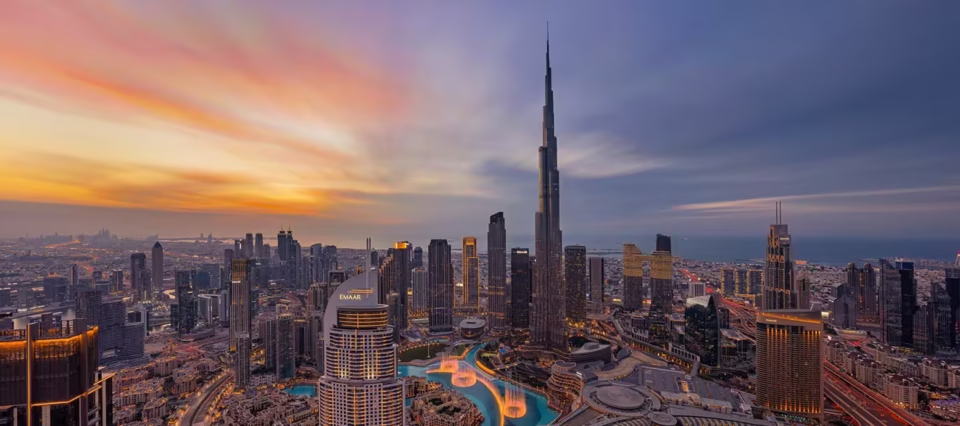
In the newly released Euromonitor International Top 100 City Destinations Index 2025, produced in partnership with Lighthouse, cities like Dubai, Abu Dhabi and Medina are showing the world exactly how future-ready, guest-obsessed, AI-powered tourism is done. While the Index ranks 100 global cities across more than 50 indicators, it’s the Middle Eastern contenders who are rewriting the rulebook on what urban travel excellence looks like.
Combining innovation, top-tier infrastructure, sustainability ambitions and shockingly smooth visitor experiences, the region’s destinations continue to outpace global tourism recovery. And in 2025, it’s all about value over volume. Cities are no longer chasing stampedes of sightseers. Instead they are wooing travellers who stay longer, spend more and behave responsibly. The Middle East, with its high-tech shiny airports, sophisticated urban planning and hyper-efficient crowd management, is an absolute poster child for this shift.
At the heart of the Index lies a holistic framework covering economic vitality, tourism performance, infrastructure, health and safely, sustainability, and policy effectiveness. Yet in 2025, one factor stands out above the rest, and that is AI readiness. The cities investing in AI, including the UAE’s biggest hitters, are powering ahead by optimising transport, enhancing personalisation, fuelling business innovation and managing visitor flows with near-sci-fi precision.
Dubai and Medina shine in tourism performance
Let’s get straight to the juicy bit: in the Tourism Performance pillar, the competition is fierce, but Dubai continues to reign supreme in international tourism demand, thanks to its relentless promotional campaigns, world-class connectivity and ambitious AI-led enhancements. Tourism remains a central pillar of the UAE Economic Agenda, with Dubai charging full speed ahead towards its target of 40 million visitors a year by 2031, aligning with the Abu Dhabi Tourism Strategy 2030.
Meanwhile, Medina is the pillar’s breakout star, recording the largest gains of any city due to soaring hotel occupancy, growing airport traffic and expanded airline routes. The city’s strategic investments are paying off, as it cements itself as one of the fastest-rising global tourism powerhouses.
Across the Atlantic, Orlando clinched the overall Tourism Performance crown, nudging past New York, while Paris held strong thanks to post-Olympic momentum, but only three cities worldwide made the top 20 for both domestic and international demand: Orlando, Medina and Los Angeles. That’s some very good company for Medina indeed.
Global arrivals
Across the full Top 100 Index, the world’s leading destinations are expected to welcome 702 million international trips in 2025, growing 8% year-on-year and outpacing global tourism growth (a humble 4%). Bangkok once again tops the international arrivals chart with 30 million visitors, while Hong Kong and Macau follow with their own impressive momentum.
Yet it’s Middle Eastern destinations, with their powerhouse airport hubs, gleaming cityscapes and frictionless guest experiences, that are rapidly shaping the future of global urban tourism. Whether it’s Abu Dhabi’s hyperconnected airport expansion, Doha’s cultural and sporting megaprojects, or Riyadh’s turbocharged Vision 2030 initiatives, the region is redefining what a “must-visit” city looks like.
The smart city future
Here’s where the Middle East leaves the rest of the world sweating: AI adoption and smart city innovation. Cities like Abu Dhabi and Dubai are already rolling out digital governance systems, autonomous services, optimised transport networks, AI-driven visitor management and pioneering start-up accelerators. It’s not science fiction it’s the UAE on a regular Tuesday.
As AI becomes the great differentiator in global tourism competitiveness, the region’s bold leadership is setting the pace. But with great power comes great responsibility: global alignment on AI ethics, data protection, and bias prevention remains essential to ensure that this supercharged innovation benefits residents and visitors alike.
2025 in a nutshell
Urban destinations worldwide are learning that attracting high-value, responsible travellers is far more sustainable, and significantly more profitable, than chasing tourism crowds. With some of the world’s most advanced airports, smartest cities, and most ambitious tourism agendas, Middle Eastern cities are leading the charge in reshaping what global travel looks like.
What do we think of the future of tourism? To us, it’s looking bright, intelligent and experience-rich. And increasingly, Middle Eastern.