

Fuelled by mega-projects, global events, and ambitious national strategies, the Middle East has been on an upward trajectory for tourism figures. However, ongoing political uncertainty has triggered a sharp turnaround in inbound travel, and these interruptions have had a massive impact.
But the question remains, is this merely a short-term interruption, or a long-term setback? And what are the statistics from Tourism Economics telling us? The data points to a challenging year ahead, but it also reveals something more important: the region has the tools, strategy, and resilience to recover, quickly.
The short-term shock
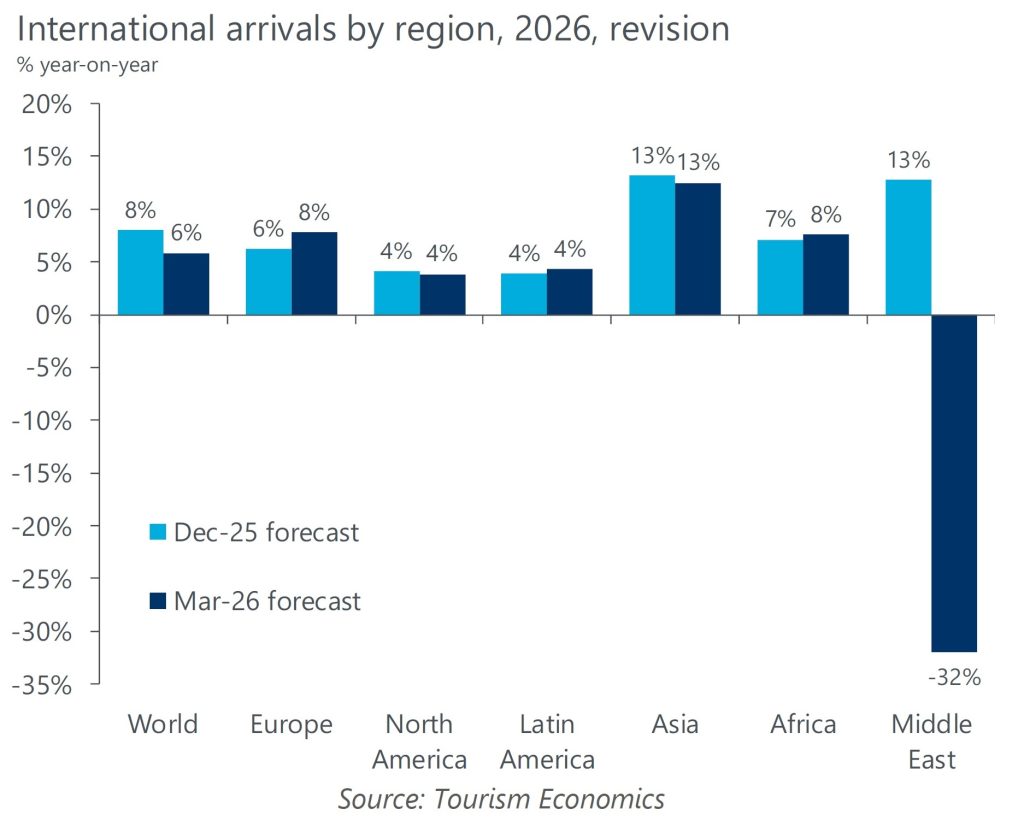
There’s no denying the scale of the near-term impact. According to Tourism Economics, inbound arrivals to the Middle East are expected to fall 32% in 2026, with the GCC seeing a 30% decline, equivalent to around $38 billion in lost tourism spend.
Passenger arrivals across the GCC are also forecast to drop by 11%, a significant downgrade from earlier expectations. War is disrupting air transport, as airlines cut schedules and travellers avoid routes to and through the region. The decline is expected to be temporary, and although sentiment will stay low this year, it’s predicted there will be a strong rebound in 2027-2028.
A disconnect in the air
Tourism has been hit hardest through disruptions to air travel and regional connectivity. According to Tourism Economics, major airlines are operating well below normal capacity with 44 airlines suspended services, removing approximately 245,000 weekly seats at the peak.
“According to OAG data for the week commencing 23 March, Emirates was operating at 40% below normal capacity, Etihad at 50% below, and Qatar Airways at 62% below.” – Tourism Economics
As both a destination and a global aviation hub, the GCC is particularly exposed to these disruptions, especially markets like the UAE and Saudi Arabia, which rely heavily on international air arrivals.
Early signs of resilience
Despite the downturn, tourism activity has not collapsed entirely. Short-haul and domestic travel are continuing at reduced levels, demand has remained visible during key periods such as Eid, and regional travel is acting as a temporary buffer against lost long-haul demand, this suggests that while international sentiment has weakened, underlying demand, particularly closer to home, remains intact.
Read More: The Middle East Double Down on Domestic Demand
An impact on GDP
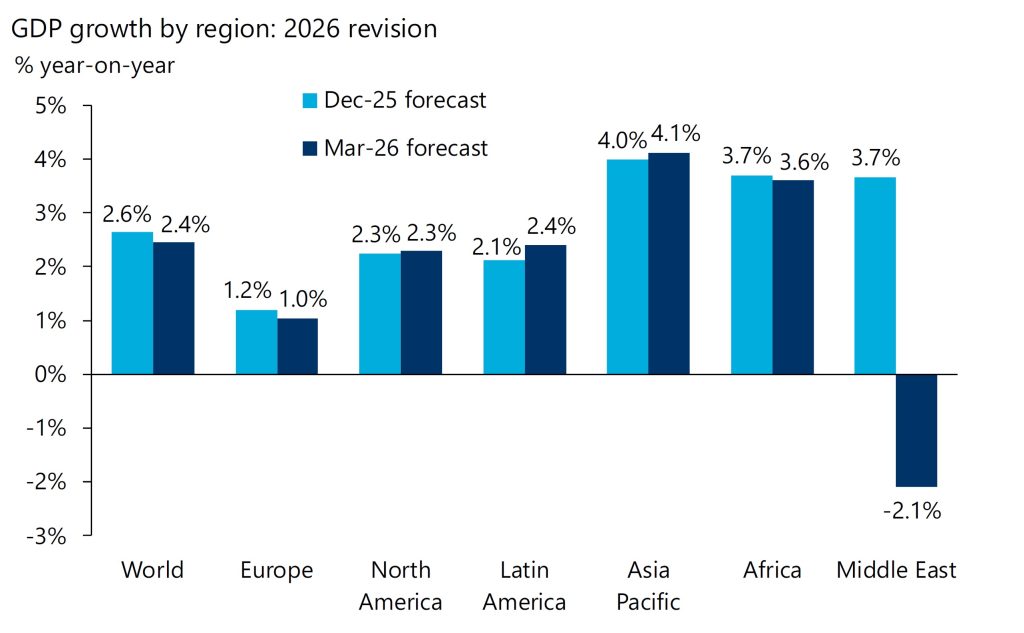
In the UAE, where tourism makes up about 13% of the economy, the impact is already showing. The services sector, especially hotels, restaurants, and travel, are expected to shrink, which helps explain why the overall GDP forecast for the Middle East is now -2.1%.
That said, the UAE is far from on the back foot. With a massive AED 1 trillion resilience package and strong financial buffers in place, it’s well positioned to steady things in the short term, and importantly, to bounce back quickly once traveller confidence starts to return.
A temporary setback, not a structural shift
While the GCC faces a clear short-term slowdown, the building blocks for recovery are firmly in place already, and the region’s role as a global travel hub means it can be highly flexible and responsive.
Saudi Arabia, for example, continues to advance its Vision 2030 tourism agenda, with 93% of key targets already met and a $1.86 trillion investment pipeline supporting long-term growth. Meanwhile, the UAE has one of the most diversified tourism economies in the world, and with its recent AED 1 trillion resilience package, it has the support in place to rebound from the setbacks this year. Plus, the wider GCC has spent years building world-class aviation hubs, hospitality assets, and destination experiences designed to offer more than just beaches.
What can the region do to rebound quicker?
While the immediate outlook is challenging, the region is far from powerless. In fact, several opportunities can be leveraged for recovery, and even strengthen long-term positioning.
- Lean further into short-haul and regional travel: Short-haul and domestic travel are expected to recover fully first. Strengthening inter-GCC tourism through simplified visa processes, regional campaigns, and competitive pricing can help offset lost long-haul demand in the near term.
- Rebuild air connectivity strategically: As airspace stabilises, restoring capacity will be critical. Prioritising key long-haul routes and incentivising airline returns can accelerate inbound recovery, particularly from high-spending markets. Plus, this is likely where the most traveller confidence is lacking right now. Bringing this back to full capacity with be a key milestone to full rebound.
- Look at value and experiential differences: With global travellers becoming more price-sensitive, destinations that offer strong value-for-money and unique experiences will have an edge. The Middle East’s mix of luxury, culture, and entertainment remains a powerful draw if positioned correctly.
- Be active on perception and trust: Tourism is driven by perception as much as reality. Clear communication, safety messaging, and coordinated branding campaigns will be essential to rebuilding traveller confidence and restoring forward bookings.
- Continued investment: The region’s commitment to long-term tourism investment between its mega-projects and infrastructure, to its destination development should not waver. Destinations which invest during downturns are best positioned to capture demand when it returns.

It’s not a question of if, it’s a question of when…
From the data we can see that the Middle East’s tourism slowdown is real, but it’s also temporary. For a region with deep investment, strong fundamentals, and a clear long-term vision, along with existing infrastructure, and government support, it’s clear the Middle East won’t just recover, it will thrive.
In global tourism, momentum can shift quickly. And for the Middle East, the conditions for a strong comeback are already taking shape. The only question left is, how long will it take to recover the $38bn loss in travel spend?
A big thank you to Tourism Economics for sharing their insights, and sharing their data/reports with us.