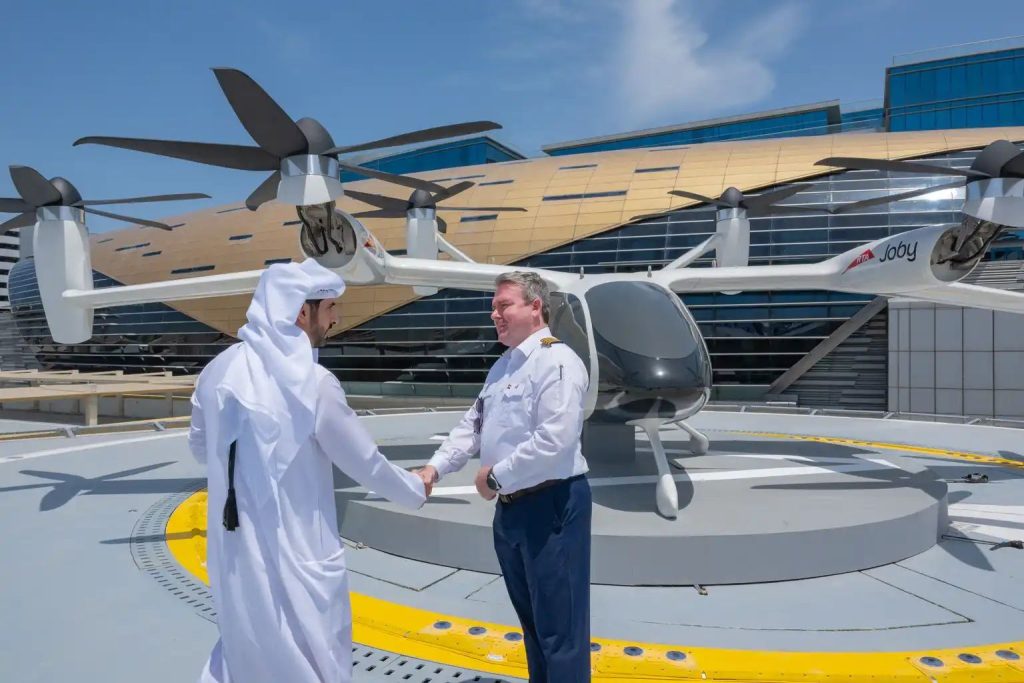
The unveiling of Dubai’s first purpose-built air taxi station near DXB marks more than an infrastructure milestone, but it shows the beginning of a transformative era in how cities move, connect, and evolve.
During a recent visit, Sheikh Hamdan bin Mohammed bin Rashid Al Maktoum described the project as a “strategic leap” in advancing Dubai’s ambition to lead the future of urban mobility. His remarks reflect a broader vision set by Sheikh Mohammed bin Rashid Al Maktoum, one that positions Dubai as a global testbed for innovation and future-ready solutions.
A new layer of mobility
The newly completed station, developed by Skyports Infrastructure in partnership with Joby Aviation spans 3,100 sqm, and is designed to handle up to 170,000 passengers per year. It features:
- Dedicated vertical take-off and landing pads
- Electric charging infrastructure
- Climate-controlled passenger terminals
- Seamless integration with existing transport systems
This is not a standalone innovation, it’s part of a carefully designed ecosystem overseen by Dubai’s Roads and Transport Authority (RTA), ensuring connectivity between air taxis, metro lines, buses, and micro-mobility solutions.
Transforming time and cities
One of the most compelling aspects of the air taxi network is its impact on travel time. Traditionally a journey from DXB to Palm Jumeirah takes about 45 minutes by car, but with the air taxi, it will take just 10 minutes.
This is not just about convenience, it’s reshaping how people experience distance, productivity, and urban life. Business districts, residential areas, and tourist destinations are able to become more tightly connected and accessible.
For a global hub like Dubai, where time efficiency is a critical economic driver, this innovation enhances competitiveness and attractiveness for both residents and international visitors.
Where sustainability meets innovation
At the heart of this initiative is a commitment to sustainability with the aircraft being fully electric, producing zero operational emissions and a lot less noise (up to 100 times quieter) than traditional helicopters.
This aligns with Dubai’s broader environmental goals while addressing one of the major challenges of urban aviation, community acceptance. Quiet, clean, and efficient air mobility makes large-scale adoption far more viable.
The implications extend far beyond transport, with the air taxi ecosystem is expected to:
- Generate high-skilled jobs in aviation, engineering, and operations
- Attract global investment in advanced air mobility
- Strengthen Dubai’s role as a regional innovation hub
- Accelerate the development of smart city infrastructure
A signal to the rest of the world
Dubai’s approach is particularly significant because it moves beyond experimentation into implementation. While many cities are still testing concepts, Dubai is building a functioning network with planned stations in Downtown, Palm Jumeirah, and Dubai Marina.
This sends a clear signal globally, that the future of urban air mobility is no longer theoretical, it is operational. The successful piloted flights conducted in 2025, including a 17-minute journey between Margham and Al Maktoum International Airport, demonstrated not only technical feasibility but also readiness for real-world conditions, including extreme desert climates.
Entering the air taxi era
With commercial operations targeted for launch by the end of 2026, the air taxi station near DXB represents just the beginning. Dubai’s model, integrating advanced technology, regulatory readiness, and infrastructure development, offers a blueprint for other global cities navigating congestion, sustainability challenges, and rapid urbanisation.