
The Middle East’s travel sector is proving, once again, that resilience is one of its defining traits. After a sharp shock following the escalation of global tensions involving Iran in late February, the region is now showing clear and measurable signs of recovery, offering reassurance to both travellers and the trade.
The return to the skies
In the immediate aftermath of airspace closures, disruption was severe. Within 48 hours, thousands of flights were cancelled and key regional corridors were effectively shut down. At its peak earlier in March, cancellation rates reached around 65% across parts of the Middle East. Fast forward just a few weeks, and the picture has shifted dramatically. By 23 March, cancellations had dropped to around 13%, with flight activity starting to rebuild.
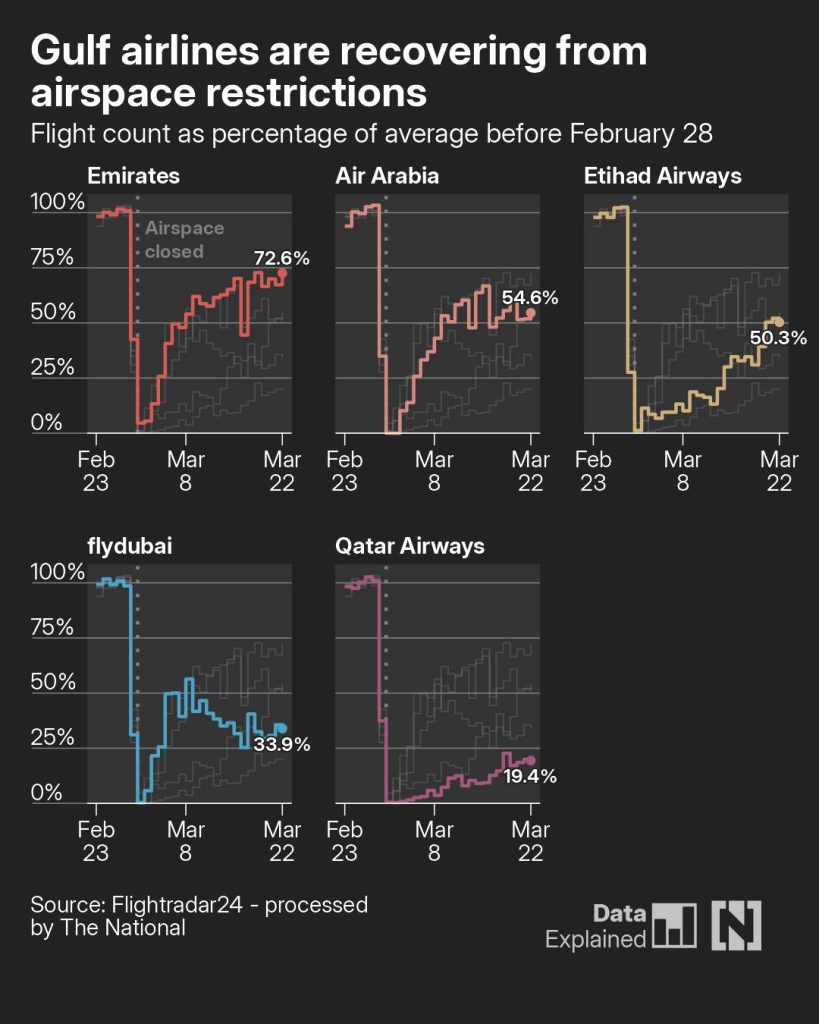
Data from FlightRadar24 and regional carriers highlights this recovery trajectory:
- Emirates has returned to roughly 64.8% of pre-disruption flight levels
- Air Arabia is operating at 56.6%
- Etihad Airways sits at 51.8%
- flydubai has recovered to 33.9%
- Qatar Airways remains lower at 23.0%, but continues to trend upward
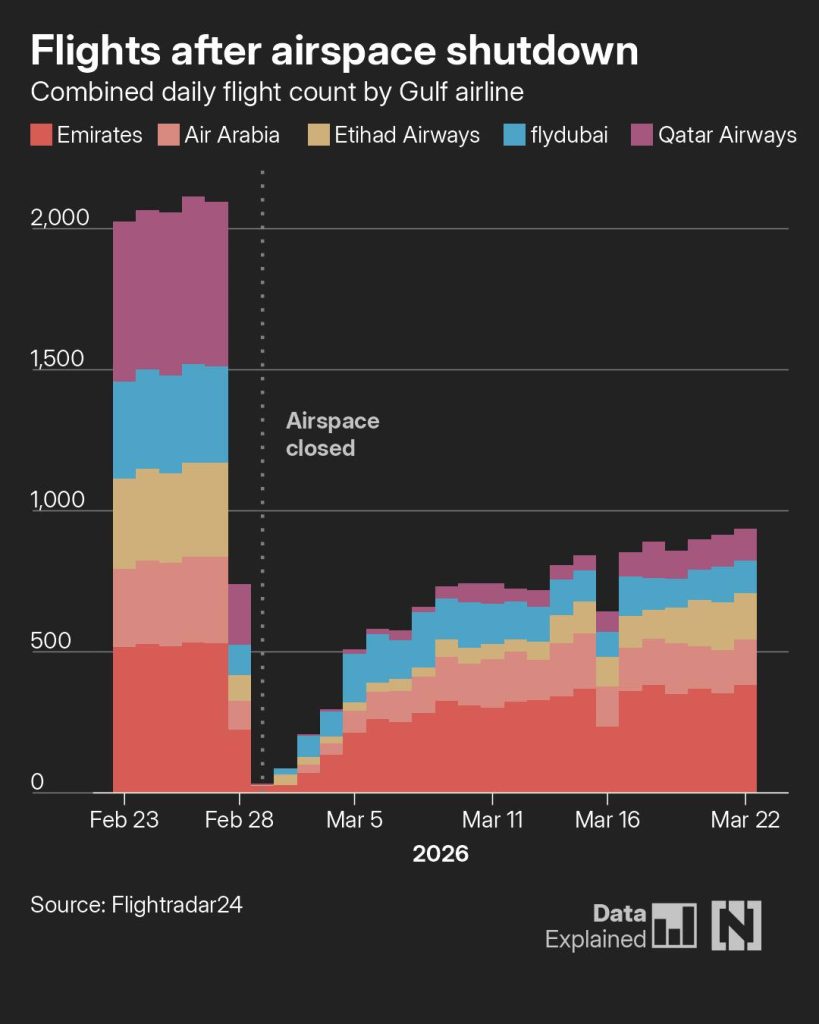
Combined flight volumes across Gulf airlines are also climbing consistently after the initial collapse following airspace closures. For travellers, this means increasing reliability. For agents, it signals that the aviation network, the operational backbone of the region, is stabilising faster than many anticipated.
Travellers are not cancelling, they’re adapting
One of the clearest insights from the latest travel trade data is that demand has not disappeared, it has shifted. Where trips have been impacted:
- Over 50% of customers are opting to reroute or change destination
- A similar proportion are postponing trips to a later date
- Only a minority are choosing full refunds without rebooking
This behaviour reflects a broader trend that travellers continue to be committed to travel but are prioritising flexibility. For agents, this shows the importance of agile itinerary management and alternative destination knowledge.
Passenger volumes are a mixed but stabilising picture
The disruption has, however, had a measurable impact on volumes, with 43% of travel businesses reporting passenger numbers down by 10% or more compared to last year. Only 27% report being ahead of 2025 levels, and the remainder are broadly flat or experiencing minor fluctuations. This “split market” shows the uneven nature of recovery, but it also highlights opportunity. As capacity returns, so too does the potential to capture deferred demand.
Profitability is uncertain but not collapsed
Despite operational improvements, financial outlooks remain cautious. Travel businesses surveyed by TTC are currently divided almost evenly:
- 34% expect to meet profit targets this year
- 34% do not
- 31% remain unsure
Rising costs, geopolitical uncertainty and deferred revenue from rebookings are all contributing factors. However, the near-equal split also indicates that a significant portion of the industry remains confident in the rebound of the region.
Strategic responses prioritise agility
Rather than making sweeping changes, most travel businesses are focusing on tactical adjustments. The most common response has been in marketing strategy, with companies redirecting spend toward stable destinations, promoting flexible booking policies, and adjusting messaging in real time based on travel advisories.
Secondary adjustments include tweaks to destination portfolios and product offerings, but wholesale strategic pivots remain rare, suggesting confidence in the long-term strength of the region.
For travel agents, the message is clear: proactivity and flexibility are key. Clients are still travelling, they simply need guidance. Those agents who are offering alternative routing options, recommending more stable destinations like Oman which is more open, and communicating early and clearly are best positioned to retain bookings and build long-term loyalty.
For travellers, confidence is gradually returning. Flight schedules are stabilising, key hubs are reopening, and the region’s core tourism infrastructure remains intact.
Looking ahead for more momentum
While challenges remain, the direction of travel is unmistakably positive. The sharp drop in cancellations, the steady return of airline capacity, and the willingness of travellers to adapt rather than cancel all point to a sector that is not only recovering, but doing so quickly. History shows that travel demand doesn’t vanish in times of crisis, it builds. And when confidence returns, it returns fast.
The Middle East, with its world-class aviation networks and diverse tourism offering, is already moving into that next phase. For both the trade and travellers, the outlook is increasingly one of cautious optimism, backed by data, driven by demand, and underpinned by resilience.